
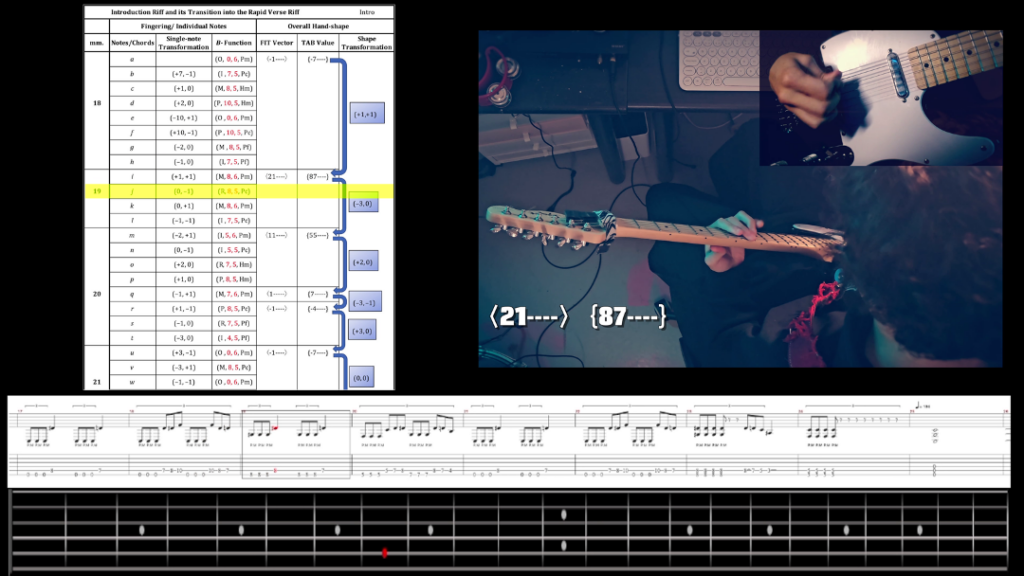
This study develops a combined analytical–performative methodology for studying heavy rock and metalcore guitar practices in the early twenty-first century, focusing on how physical interaction with the fretboard shapes musical form, expression, and stylistic identity. Rather than treating the guitar as a neutral conduit for pitch structures, the methodology understands it as a spatial, dynamic, and ergonomic system whose constraints and qualities actively participate in musical meaning-making.
Building on Jonathan De Souza’s theory of fretboard transformations, Joti Rockwell’s gestural and tonal modeling, and Timothy Koozin’s motion-based FIT vectors and hand-shape representations, the project integrates mathematical modeling with embodied performance analysis. The central claim is that heavy rock guitar music is organized not only by harmonic or formal principles, but by repeatable hand shapes, directional motion patterns, and fretboard navigation strategies that unfold over time.
The methodology is developed and tested through two contrasting metalcore case studies: “Through Struggle” (2005) by As I Lay Dying and “HTML Rulez D00d” (2007) by The Devil Wears Prada. These works were selected for their differing formal designs and tonal organizations—one cyclic and thematically recurrent, the other through-composed and continuously developmental—while sharing comparable technical and stylistic constraints. By analyzing how similar goo resources generate distinct formal outcomes in each piece, the project demonstrates how localized guitar gestures scale up to produce large-scale musical coherence. Musical structure is thus understood as emerging from the interaction between bodily efficiency, spatial transformation, and genre-specific performance practice, rather than from abstract pitch relations alone.
Theoretical Foundations
The combined methodology synthesizes three primary theoretical strands, each addressing a different but complementary dimension of guitar performance:
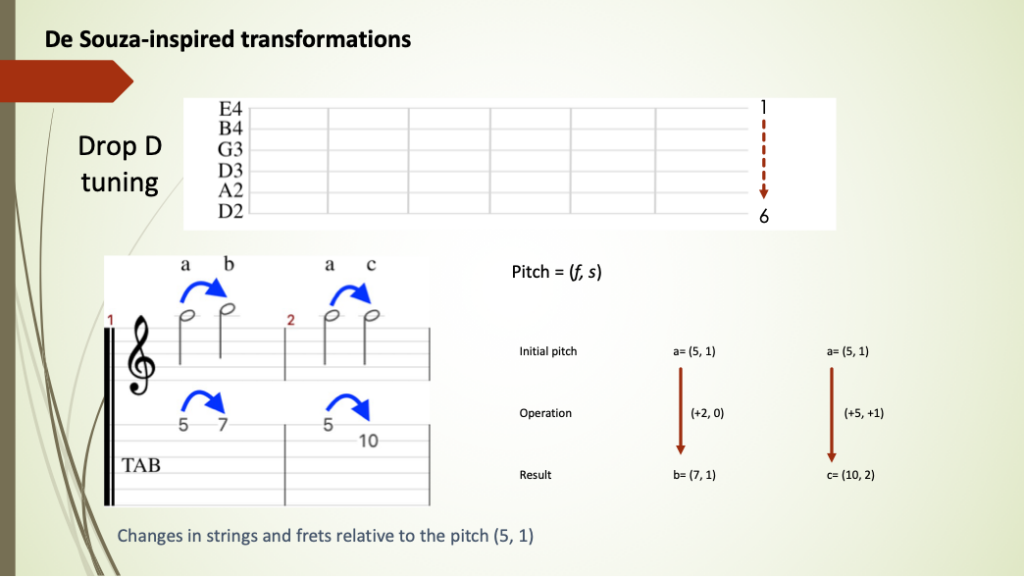
Fretboard transformations (Jonathan De Souza): De Souza’s model provides the spatial foundation of the methodology. Transformations such as translation, reflection, rotation, and reconfiguration describe how guitarists relocate and adapt fretboard patterns while preserving internal relationships. This approach foregrounds string-specific position, tuning systems, and hand placement as analytically significant rather than reducible to pitch-class equivalence.
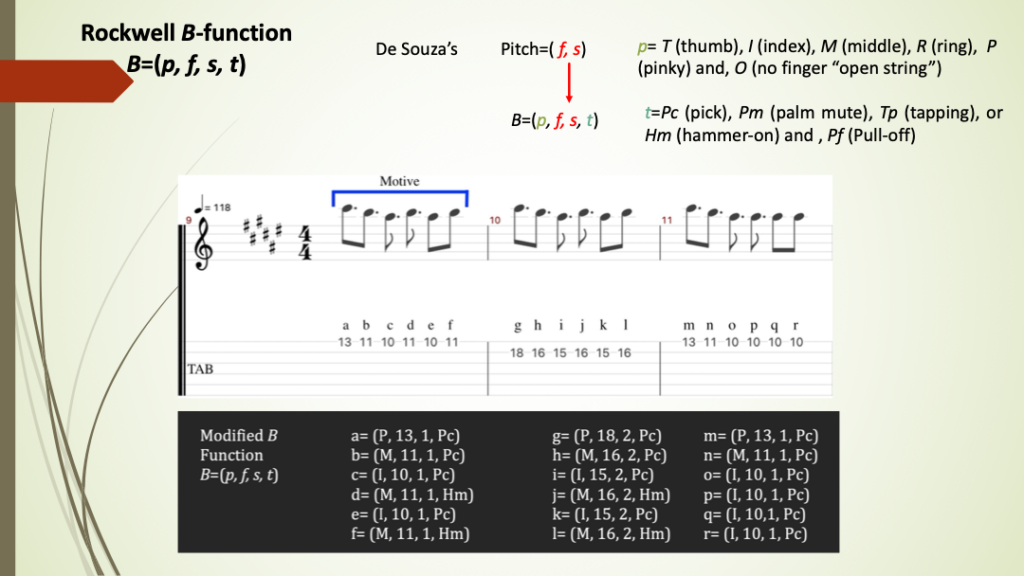
Gestural and tonal modeling (Joti Rockwell): Rockwell’s work on gesture and tonal gravity informs the project’s treatment of directional pull and harmonic tendency. His B-function is adapted and modified to reflect how guitar-based tonal centers are reinforced or destabilized through fretboard movement, registral emphasis, and chordal trajectory, particularly in riff-based textures.
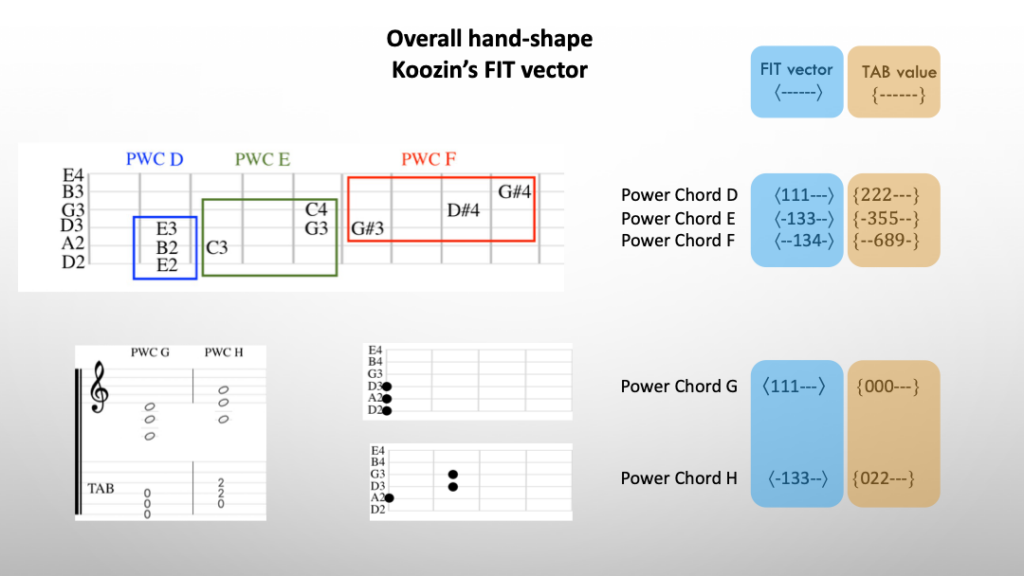
Motion vectors and hand-shape models (Timothy Koozin): Koozin’s FIT vectors and numerical hand-shape representations supply a formalized language for describing motion efficiency, finger grouping, and ergonomic consistency. Hand shapes are treated as discrete analytical units that persist, transform, and recombine across passages, while vectors capture the direction, magnitude, and effort of fretboard motion.
Together, these approaches allow the methodology to account simultaneously for where music happens on the fretboard, how the hands move through that space, and why certain movements become structurally and expressively privileged within specific genres.
Methodological Structure
The combined methodology operates as an integrated, multi-layered analytical system designed to connect micro-level performance detail with macro-level musical structure.
1. Transformational Mapping
Analyses begin by identifying core fretboard configurations—such as power-chord shapes, scalar fragments, and open-string anchors—and tracking the transformations applied to them across time. These include positional shifts, string crossings, re-fingerings, and tuning-dependent re-mappings. Crucially, transformations preserve string identity and hand shape, allowing analysts to observe how spatial continuity contributes to formal cohesion.
2. Gestural and Vector Analysis
Building on this spatial layer, the methodology applies modified Rockwell B-functions and Koozin-inspired FIT vectors to describe:
⦿Directional motion tendencies
⦿Degrees of physical effort and resistance
⦿Tonal pull created by chordal trajectories
⦿Stability or strain within evolving hand shapes
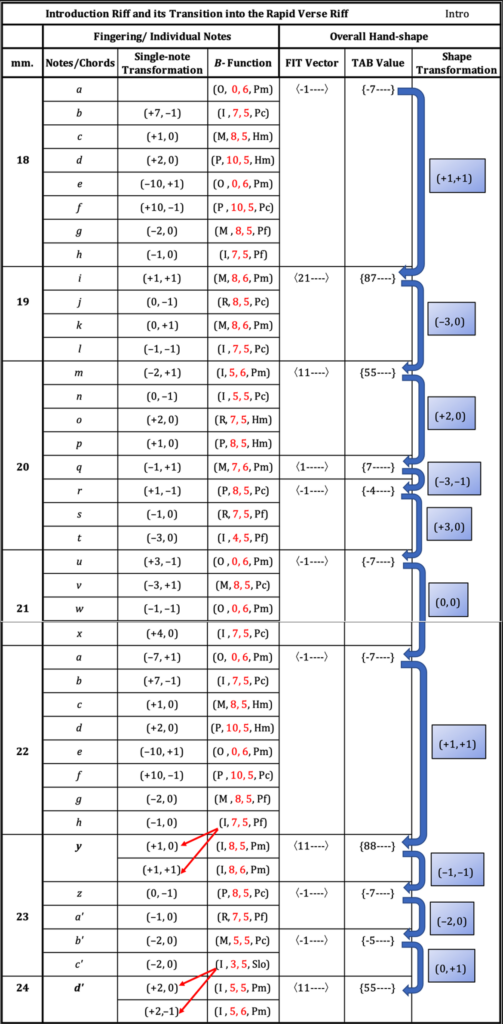
This layer captures how fretboard movement is shaped by ergonomic efficiency and gestural momentum, particularly in high-intensity passages that demand speed and precision.
Video 1. Example of the combined methodology applied to the passages chosen from case study 1, “Through Struggle” (2005) by As I Lay Dying.
Video 2. Example of the combined methodology applied to the passages chosen from case study 2, “HTML Rulez D00d” (2007) by The Devil Wears Prada.
3. Formal and Genre-Based Interpretation
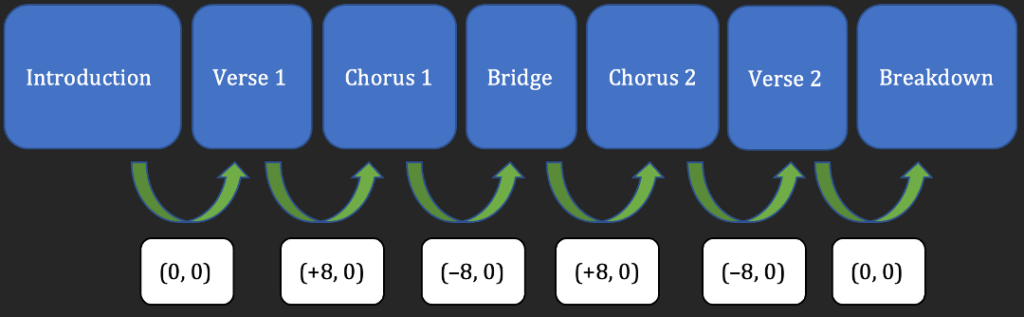
Finally, the results of spatial and gestural analysis are aligned with formal sections, tonal centers, and genre conventions. This makes it possible to show how cyclic versus through-composed forms, tonal anchoring, and sectional contrast correlate with specific transformational and vectorial profiles. Genre is thus understood as a historically stabilized set of preferred movements, shapes, and trajectories on the instrument, rather than merely a collection of stylistic surface features.
Innovation and Contribution
This project contributes to music theory and performance studies in several key ways:
It offers a fully integrated model that unites transformational theory, gestural analysis, and motion-based vectors into a single analytical framework.
It foregrounds hand shapes and physical motion as primary structural agents in heavy guitar music.
It demonstrates how formal coherence in metalcore can arise from embodied efficiency and fretboard constraint rather than harmonic complexity alone.
It provides a modular, extensible methodology that can be adapted to other string instruments, tuning systems, and repertoires.
Bibliography
Category I — Methodology
Fingering-related Techniques
De Souza, Jonathan. “Fretboard Transformations.” Music Theory Online 24, no. 2 (2018).
De Souza, Jonathan. “Music at Hand: Instruments, Bodies, and Cognition.” Music Theory Online 23, no. 3 (2017).
Momii, Toru. “A Transformational Approach to Gesture in Shō Performance.” Music Theory Online 26, no. 2 (2020).
Momii, Toru. “Performing Te: Gesture and Timbre in Fujikura Dai’s neo for Solo Shamisen.” Music Theory Spectrum 46, no. 2 (2024).
Rockwell, Joti. “Banjo Transformations and Bluegrass Rhythm.” Journal of the American Musicological Society 62, no. 3 (2009): 567–636.
Shea, Nicholas J. “The Feel of the Guitar in Popular Music Performance.” SMT-V: Videocast Journal of the Society for Music Theory 8, no. 3 (May 2022).
Hand–shape Analysis
Capuzzo, Guy. “Neo-Riemannian Theory and the Analysis of Pop-Rock Music.” Music Theory Spectrum 26, no. 2 (2004): 177–199.
Capuzzo, Guy. “Simultaneous Distinct Headbanging Patterns in Heavy Metal.” Society for Music Theory: Videocast Journal, SMT-V 10, no. 4 (2024).
Koozin, Timothy. “Guitar Voicing in Pop-Rock Music: A Performance-Based Analytical Approach.” Music Theory Online 17, no. 3 (2011).
Formal Process and Riffs
Easley, David B. “Riff Schemes, Form, and the Genre of Early American Hardcore Punk.” Music Theory Spectrum 37, no. 1 (2015): 25–41.
Hudson, Stephen S. “Compound AABA Form and Style Distinction in Heavy Metal.” Journal of Music Theory Pedagogy 34, no. 2 (2020): 123–45.
Van Valkenburg, Aaron. “Musical Process and the Structuring of Riffs in Metallica.” Master’s thesis, Baylor University, 2017.