
CESAR ALBERTO AREVALO MARTINEZ
Abstract
This article presents a condensed version of a larger study on fretboard transformations and formal process in early twenty-first-century heavy rock guitar music. It focuses on one representative metalcore case study, As I Lay Dying’s “Through Struggle” (2005), and asks how the physical organization of the guitar fretboard shapes riff construction, technical execution, and sectional design. Drawing on Jonathan De Souza’s fretboard transformations, Joti Rockwell’s instrumental-gesture modeling, and Timothy Koozin’s fret-interval vector, the article develops a combined methodology for describing both individual finger actions and larger hand-shape movements. The case study concentrates on the final intricate fast riff and its transition into the concluding breakdown, a passage in which rapid string crossing, mixed picking, power-chord insertion, and a sudden tempo reduction interact to create a climactic formal event. The analysis shows that metalcore complexity does not necessarily depend on expansive fretboard displacement; in “Through Struggle,” the most technically demanding passage is built from relatively compact shapes whose difficulty emerges through density, articulation, and synchronization. At the formal level, the song remains grounded in C minor, with the chorus providing the most significant harmonic departure through a move to A-flat major. By connecting local technique to global form, the article argues that fretboard analysis can clarify how heavy rock pieces organize musical tension through embodied performance, not only through pitch or harmony in the abstract.
Keywords: fretboard transformations; metalcore; guitar analysis; hand-shape analysis; riff; formal process; As I Lay Dying
Introduction
The early twenty-first century has witnessed an expansion of expressive possibilities in guitar-oriented music, particularly within subgenres of heavy rock and metalcore. These musical styles are characterized by high levels of technical precision, textural complexity, and formal experimentation—qualities that challenge traditional modes of music analysis. While studies in music theory have developed tools to examine pitch-class relationships, harmonic progressions, and large-scale form, there is a modest amount of scholar production accounted for the embodied, spatial, and mechanical realities of guitar performance. This article contributes to this field by proposing and applying a unique analytical framework—referred to here as the “combined methodology”—that unites transformational theory, fretboard geometry, and motion-based vector analysis to examine how guitarists structure and perform music in the heavy rock idiom.
This study builds upon recent scholarly efforts to incorporate bodily performance into music analysis, most notably the fretboard-centered transformational work of Jonathan De Souza (2017, 2021), the motion-oriented FIT vectors of Timothy Koozin (2011), and the spatial modeling of chordal shifts through modified B-functions as developed by Joti Rockwell (2021). However, where each of these methods primarily focuses on one layer of performance—be it pitch space, motion efficiency, or tonal gravity—this article argues that a multi-dimensional approach is necessary to fully understand the interaction between technical articulation and formal structure in heavy guitar-based music. The combined methodology integrates these perspectives to create a data-rich, performance-informed model that reveals both micro-level details (such as hand positioning, picking patterns, and fretboard navigation) and macro-level structures (such as sectional form and tonal coherence).
To ground this theoretical model in practice, this article examines two representative case studies drawn from the metalcore genre: “Through Struggle” (2005) by As I Lay Dying and “HTML Rulez D00d” (2007) by The Devil Wears Prada. These pieces were selected for their contrasting formal designs and varied applications of fretboard technique, allowing for a comparative exploration of compositional strategies and performance practice. The former is more cyclic in its formal construction, relying on recurring thematic and tonal material centered in C minor, while the latter exhibits a through-composed structure that continuously introduces new material, grounded largely in D minor. Both pieces, however, display the genre’s characteristic balance of tonal cohesion and physical intensity—a duality that the combined methodology is purposely positioned to articulate.
In the course of this analysis, several key insights emerge. First, fretboard transformations reveal how guitarists economize movement and manage ergonomic constraints when navigating technically demanding passages. These findings underscore the role of performer choice in shaping musical outcomes, particularly in genres where speed, precision, and aggressive articulation are central to the style. Second, by aligning fretboard positions with harmonic and formal markers, the analysis uncovers recurring patterns of hand shape evolution and vectorized motion that contribute to the expressive and structural arc of each composition. These transformations frequently involve not just the movement of single fingers or note clusters, but complete hand shapes that reflect strategic decisions about economy of motion and technical practicality. Third, when extended to the broader form of the piece, the methodology illustrates how harmonic centers, formal boundaries, and sectional contrasts correlate with specific transformational values, contributing to the construction of musical narratives grounded in embodied performance.
The structure of this article is as follows. The methodology section introduces the theoretical foundations of the combined methodology, tracing its roots through transformational theory, guitar performance studies, and motion analysis. It also presents the necessary terminology, tuning systems, and analytical conventions. The case study applies my combined methodology to “Through Struggle”, analyzing how fretboard transformations intersect with the song’s formal and harmonic structure. The broader thesis conducts another analysis of “HTML Rulez D00d”, highlighting how a through-composed formal framework interacts with a similarly constrained fretboard and tonal space. Each chapter concludes with a detailed breakdown of riff-level analyses and large-scale transformation charts. The final chapter concludes the findings of both case studies, assesses the methodological strengths and limitations, and proposes directions for expanding the scope and application of fretboard-based analytical approaches.
By bridging the domains of formal analysis, embodied performance, and technological modeling, this article contributes to a growing body of scholarship that seeks to reconceive musical structure not as an abstract system of relations, but as a settled, gestural, and contextually grounded experience. The guitar is not merely a channel for harmonic material—it is a spatial and kinetic environment in which music is shaped by the interaction of hand, string, fret, and motion. The analytical tools developed here aim to make that environment visible, offering new ways to understand the complexity, coherence, and physicality of contemporary heavy rock guitar music.
The present article narrows that broader project into a single case study and a shorter methodological exposition. Rather than retaining the second case study and appendix material, it concentrates on the tools most necessary for analyzing fingering, hand shape, and formal process in “Through Struggle.” This narrower frame follows the general article format modeled by Wu’s study of meter and voice leading: a focused analytical problem is introduced, relevant theoretical tools are established with footnoted scholarly context, and one passage is examined in enough detail to show how the method works in practice.
Literature Review
Fingering-Related Techniques
De Souza’s article “Fretboard Transformations” develops a transformational approach to the fretboard, exploring intersections between frets and strings.[1] By extending these dimensions into a generalized fretboard space, De Souza introduces analytical methods for describing intervals, transformations, and multiple realizations of the same pitch across the guitar.
De Souza’s pitch representation (f, s), where f denotes fret and s denotes string, is especially useful because the same pitch can appear in different physical locations. This distinction is central to guitar analysis: a passage may repeat the same sounding pitch material while changing string placement, timbre, warmth, or ease of execution. The fretboard is therefore not a neutral pitch surface but a spatial field that shapes musical decision-making.
Rockwell’s study of banjo technique offers a complementary model for connecting instrumental mechanics to gesture.[2] His B-function, originally designed to account for plucking finger, fretboard position, string, and time point, can be adapted for rock guitar by redefining the first element as the fretting finger and the final element as the technique used to produce the event. In this article, the adapted B-function is written as B = (p, f, s, t), where p represents the fretting finger, f the fret, s the string, and t a technique such as picking, palm muting, pull-off, slide, bend, or harmonic.
Momii’s work on gesture and timbre in shamisen and shō performance further supports the idea that instrumental technique can be modeled visually and transformationally.[3] His attention to the relationship between physical action and sound suggests a productive way to represent guitar gestures such as slides, bends, vibrato, and power-chord shifts. In heavy rock, these gestures are not merely ornamental; they help define the sound world and physical intensity of the genre.
Power chords provide a particularly important bridge between technique, harmony, and timbre.[4] Their common shapes in drop tunings allow guitarists to produce low, aggressive sonorities with relatively simple left-hand positions. Yet those simple shapes can become formally significant when they appear at structural boundaries, especially when a fast riff collapses into a slower breakdown.
Shea’s work on the feel of the guitar in popular music performance reinforces this embodied perspective by emphasizing tactile contact, hand position, and the physical relation between player and instrument.[5] Although Shea does not provide the present article’s mathematical procedure, his performance-centered orientation helps justify why fretboard position and fingering choice should be treated as analytical evidence rather than peripheral performance detail.
In m. 10, the initial motive (m. 9) is repeated but played on the second string of the guitar. Notice how the pitches remain exactly the same in both measures, but the pitch function and TAB system differ, highlighting the alternate execution of the notes. This distinction would not be evident in traditional music notation. Another reason why we agreed on performing and recording this motive by playing its repetition on the second string is the fact that the chord accompanying the repetition in m. 10 makes use of a ninth interval played in the third string (rhythmic guitar), making it brighter in comparison with the chord in m. 9 which aims to keep a darker sound using only the sixth, fifth and fourth strings. Playing this motive in the second string makes the sound warmer and darker to accompany a brighter harmony in the rhythmic guitar, keeping a balance between the darker rhythmic guitar against a brighter melody in the previous measure. A subtle, perhaps unnoticeable detail that exemplifies the level of attention that some musicians can dedicate to their work when producing and arranging music in the recording studio.
To further elaborate on the three-note motive and its representation on the fretboard, we can introduce a system of notation using “+” and “–” signs to indicate changes in strings and frets relative to the starting pitch. Taking the first pitch of the motive as the reference point, a “+” sign denotes upward movement to a higher fret or string, while a “–” sign indicates downward movement to a lower fret or string. This approach provides an intuitive and flexible way to track transformations across the fretboard. For example, in Figure 1.2, starting on the first string at the fifth fret (5, 1) corresponding to an A4, a move to the 7th fret can be denoted as (+2, 0), representing an increase of two frets in the same string. Similarly, transitioning to the second string while maintaining the same pitch can be represented as (+5, +1), signifying a string drop and a fret position adjustment (10, 2). This system, integrated within De Souza’s pitch representation = (f, s) model, offers a clear framework for analyzing both the spatial and musical relationships in fretboard navigation.
In Figure 1.3, these transformations are applied to the motives involved in the musical example in Figure 1.1. Notice how the main string leap operations occur only at the beginning of mm. 10 and 11 to indicate the change of string and its corresponding fret position. It is also worth mentioning the upside-down behavior of these operations (string change), which is due to the counterintuitive conventional label of the strings, where the E4 is the first one and the low E2 is the sixth. Notice how the main motive has a first movement of two frets from the initial pitch, followed by four small changes of 1 fret. These are the kind of gestures that can be examined thoroughly by finding patterns in the operations involved (De Souza’s transformations f, s) and the execution of each note (Rockwell’s adapted B function). These two methodologies constitute the main objective/mathematical way of analysis for the heavy rock pieces that will be studied in order to dive into the aspects of execution, technique, and form of this rock music style.
Overall Hand-Shape Techniques
While fingering-related techniques can be tracked through De Souza’s transformations and the adapted B-function, these tools do not always provide a clear representation of the hand as a whole. Koozin’s fret-interval vector fills this gap by representing the overall spatial structure of guitar voicings and hand shapes.[6]
Koozin’s “Guitar Voicing in Pop-Rock Music” is therefore central to the second part of the method.[7] His fret-interval type (FIT) vector reduces a guitar shape to relative fret positions, allowing the analyst to compare gestures independently of their absolute location on the neck. This is especially useful in rock and metal, where a repeated shape may move across the fretboard while retaining its kinesthetic identity.
In this article, TAB values describe absolute fret positions, while FIT vectors describe relative hand-shape identity. Silent strings are represented with a dash.[8] FIT vectors are enclosed in angle brackets.[9] This notational distinction allows the analysis to identify when a guitarist changes pitch location without substantially changing the contour of the hand.
Capuzzo’s work on transformational approaches to pop-rock harmony provides another relevant background for this project, especially because it treats popular music as a repertoire in which transformational relations can clarify musical process.[10] His later work on headbanging patterns in heavy metal also points toward the broader embodied dimensions of the genre.[11] Together with De Souza, Rockwell, Momii, Shea, and Koozin, these studies support a method that treats pitch, gesture, technique, and form as mutually implicated.
While the first category focuses on fingering-related techniques by applying De Souza’s transformations to a modified version of Rockwell’s B (banjo) function, this approach however, has several significant limitations. Specifically, it generates detailed vectors for each finger position within a chord or shape but does not provide a clear representation of the overall hand shape. This lack of a broader perspective makes it harder to grasp how the hand as a whole interacts with the fretboard, especially when analyzing movements between positions. To address this issue, I turn to Timothy Koozin’s “fret-interval” vector, which captures the overall structure of the hand in a way that is simpler and easier to interpret. By integrating this method, we can complement the more mathematically detailed analysis of individual finger positions with a broader view of how hand shapes transform and move across the fretboard. This combined approach allows us to analyze fretboard transformations with both precision and clarity.
De Souza’s analytical technique of fretboard transformations is a key reference for this section, as it also highlights the importance of spatial and visual patterns on the guitar’s fretboard. He shows how guitarists rely on the grid-like layout of the fretboard to create and manipulate shapes, making these patterns a tactile and visual experience rather than just a theoretical concept. This perspective helps us understand how players navigate and transform hand shapes as they move across the fretboard, adapting to different musical contexts. However, when it comes to developing a theory which encapsules the different hand shapes that can be built across the fretboard, Koozin’s 2011 article “Guitar Voicing in Pop-Rock Music: A Performance-Based Analytical Approach” provides a very complete and efficient method to represent chords and hand positions. Koozin focuses on how the physical layout of the guitar influences chord voicings and overall hand movements. He explores how a guitarist’s choices are molded by the relationship between hand positions and the fretboard’s geometry, connecting these physical aspects to the harmonic possibilities of the instrument. By examining these patterns, Koozin bridges the gap between music theory and the practical realities of performance.
One of Koozin’s most useful contributions is the fret-interval type (FIT) vector, which captures the spatial relationships between fingers on the fretboard. This tool provides a way to mathematically analyze the whole hand shapes and their movements, offering a structured method to study how these shapes shift across the guitar neck. Using the FIT vector, we can better understand the interplay between physical motion and musical meaning, making it an invaluable tool for studying fretboard transformations.
This method is similar to guitar tablature (TAB), where each digit represents the fret position on a specific string. The first digit corresponds to the fret on the sixth string (the thickest), the second digit indicates the fret on the fifth string, the third digit represents the fret on the fourth string, and so on until the sixth (last) digit, which represents the fret number on the first string (the thinnest). As Koozin explains, “the fret numberings are reduced by the factor that represents the lower boundary or barre as 1.” In simple words, the number 1 in a fret-interval type represents the lowest position within the shape, rather than indicating the first fret.
Notice how in a TAB context, the power chord D would be represented with the series of numbers 222— since this chord is executed on the second fret (I will locate TAB digits and signs within curly brackets “” and FIT vector numbers inside “〈 〉” brackets to refer to, since this is the original denomination Koozin implemented in his research). However, due to the FIT focus on relative notation, the hand shape vector must be represented with its lowest fret possible value (“boundary”), which in this case corresponds to fret number one. Consequently, we represent this power chord with the vector 〈111—〉, as this is the lowest form in which this shape can be executed. The same analysis applies to PC E, whose root note is located on the third fret of the fifth string 〈-355–〉, its FIT vector corresponds with the lowest location in which this hand shape can be executed 〈-133–〉. Finally, we applied the same procedure to obtain the FIT vector of PC F, where its TAB depiction would be 〈–689-〉 and its FIT vector 〈–134-〉, corresponding with the lowest location where this shape can be executed on the fretboard.
As a guitar player, one of the first questions that arises about implementing the FIT is how to represent open strings if the main focus of this method is on numbered frets? When Koozin examines voicings that incorporate open strings, it might seem logical to represent them with 0s, doing so would conflict with the focus of FIT on relative positioning. Instead, in this framework, an open string is always represented as 1, since this fret number serves as the lowest boundary. Consequently, as can be seen in Figure 1.7, the fret-interval vector 〈111—〉(in a dropped tuning) can describe both power chords whose root note is the sixth string and the corresponding low D power chord voicing that is structured with open strings (power chord G in Figure 1.7). In the same way, the power chord whose root note corresponds with the open fifth string (PC H in Figure 1.7) is represented as 〈-133–〉 and so on.
I would like to recall Jonathan De Souza’s use of “+” and “–” signs in the pitch expression (f, s)—where f stands for fret position and s for string— and how they can be a helpful way to represent the movement of the entire hand shapes, like those described by Koozin’s fret-interval type vectors. These operations let us track shifts in both fret and string positions, making it possible to map out how shapes move across the fretboard. For example, in Figure 1.8, a power chord with its root on the sixth string in standard tuning (power chord I). When this chord shifts to a root on the fifth string (power chord J), the whole hand shape moves both vertically (to a different string) and horizontally (to a new fret position, often higher). By applying De Souza’s (f, s) operations, and the modified B function inspired by Rockwell’s article, we can break down this movement mathematically, showing how the chord’s structure and spatial leap between strings work together. This approach connects theoretical ideas about fretboard transformations with the way guitarists actually play.
Continuing with other related academic work that not only influenced central studies to our research (such as De Souza’s “fretboard Transformations” 2018) but also has key points to consider in the present research, is Guy Capuzzo’s 2004 article, “Neo-Riemannian Theory and the Analysis of Pop-Rock Music”, lays important groundwork for understanding how transformations can work in popular music, particularly when it comes to voice leading and harmonic shifts. Jonathan De Souza builds on this in Music at Hand, taking these ideas a step further by showing how they apply to the physical experience of playing the guitar. He connects Capuzzo’s focus on harmonic relationships with the tactile, spatial nature of fretboard navigation, offering a fresh perspective on how musicians engage with their instruments. For the current project on rock guitar techniques, this connection is especially valuable. It helps us see how transformations are not just abstract concepts but are tied directly to the way guitarists physically explore different tunings, styles, and sounds. Additionally, Capuzzo’s recent video article, “Simultaneous Distinct Headbanging Patterns in Heavy Metal” (2024), provides fresh insights into rhythmic complexity and embodiment in heavy metal. These concepts can enrich the current study by revealing how rhythmic and harmonic patterns intersect with fretboard transformations to define the unique character of heavy rock guitar techniques.
Methodology
This section outlines the methodological framework employed to analyze guitar performance practices, integrating the key theoretical constructs from the previous literature review. The study synthesizes De Souza’s fretboard transformations, Rockwell’s B-function, and Koozin’s fret-interval vector to construct a comprehensive approach to understanding fretboard techniques. De Souza’s transformations provide a foundational lens for examining the spatial and operational relationships on the fretboard, while Rockwell’s B-function adds a nuanced perspective on vectorial movement and ergonomic considerations. Koozin’s fret-interval vector, with its mathematical rigor, is utilized to quantify and analyze hand shapes and positional shifts. The verbal analysis of these mathematical findings is informed by the stylistic and structural insights of Easley, Hudson, and Van Valkenburg, ensuring that the study’s technical discourse is grounded in a broader musical and stylistic context.
The first methodological layer, centered on fingering-related techniques, draws heavily on De Souza’s concept of fretboard transformations. These transformations explore how guitarists navigate the fretboard through various operations, including transposition, inversion, and intervallic adjustments, providing a framework for understanding the spatial logic of guitar performance. Complementing this, Rockwell’s B-function introduces a vectorial model that emphasizes the interplay between ergonomic efficiency and musical expression. This dual focus on transformation and vectorial movement allows for a detailed examination of how fingerings and positional choices shape the expressive and technical dimensions of guitar playing.
The second methodological layer employs Koozin’s fret-interval vector to analyze hand shapes and their relationship to fretboard geometry. By quantifying intervals and positional shifts, this approach offers a precise mathematical perspective on the structural groundwork of the guitar technique. The integration of Koozin’s model enables the identification of patterns and recurring shapes that inform both technical execution and musical phrasing. This mathematical analysis is further contextualized through the verbal frameworks established by Easley, Hudson, and Van Valkenburg, ensuring that the study’s findings are articulated in a manner that resonates with existing scholarship on riff construction and stylistic nuance in heavy metal music.
While the mathematical models—De Souza-inspired transformations, the modified Rockwell B-function, and Koozin’s FIT vector—offer precise, quantitative insights into fretboard techniques, they require contextual interpretation to fully understand their implications for performance, composition, and formal process. A detailed analysis of the resultant data allows us to connect the numbers to the physicality of guitar playing, the expressive intentions of the music, and the stylistic nuances of the genre. By articulating the significance of these transformations and vectors, we can clarify how they reflect shifts in technique, movement, and musical phrasing, making the findings accessible and meaningful to a broader audience, including performers, educators, and scholars.
For this article, the method is condensed into three steps. First, each relevant pitch or chord is assigned a fretboard location, normally as (f, s). Second, each event is described through the guitar-oriented B-function B = (p, f, s, t). Third, larger shapes are represented through TAB and Koozin’s FIT vector, so that the analysis can compare the movement of individual notes with the broader ergonomic state of the left hand. The method therefore, distinguishes local fingering from global hand-shape transformation.
At the level of form, the method asks how localized technical events help articulate sectional identity. A riff may function as an introduction, verse, bridge, chorus, transition, or breakdown not merely because of its harmonic content, but because of tempo, register, articulation, density, and the bodily demands it places on the performer. Metalcore is especially suited to this approach because its formal contrasts often depend on the alternation of fast intricate riffs with slower breakdowns, and because drop tunings turn open low strings into both a sonic foundation and a physical anchor.
Finally, a crucial step in analyzing fretboard transformations within a song is establishing a clear categorization of its sections. By defining and organizing these sections, we can better understand how different transformations operate across the song’s structure and how various musical ideas interact. For case studies one and two, I will classify the songs’ sections into two main categories:
Closed Sections – Fully developed song segments with clear harmonic, rhythmic, and textural identities, such as verses, choruses, and breakdowns.
Open Sections – Transitional or fragmented passages that do not establish a stable identity but serve as bridges between larger sections. These include short instrumental breaks or anticipatory moments leading into more prominent parts of the song such as interludes and bridges.
The analytical table should therefore be read as a translation device. Its transformation column tracks movement from one event to the next; its B-function column records how the event is physically produced; its TAB column preserves the absolute fretboard position; and its FIT column abstracts the overall hand shape. The value of the combined method lies in keeping these layers distinct. A passage can show considerable motion in the B-function while remaining comparatively stable in the FIT vector, or it can show a large hand-shape transformation even when the melodic surface seems straightforward.
Case Study: “Through Struggle” by As I Lay Dying
As I Lay Dying emerged as a defining force in early 2000s metalcore, blending melodic death metal’s intricate guitar work with the raw intensity of hardcore punk. Their 2005 album Shadows Are Security helped codify a balance between melodic chorus writing, harsh vocal intensity, high-speed riffing, and groove-oriented breakdowns. “Through Struggle” is a useful case because it presents this stylistic balance with unusual clarity: the song moves between compact technical riffs and broad sectional contrasts while retaining a strong tonal anchor in drop C tuning.
The selected passage occurs near the end of the track, beginning around 3:20, where the final fast riff drives directly into the concluding breakdown. In the thesis, this passage appears both as a methodological demonstration and as part of the first extended case study. Here it becomes the article’s central analytical example because it contains, in compressed form, the main issues addressed by the methodology: fast string crossing, changing articulations, small but meaningful hand-shape operations, power-chord insertions, and a formal change from intricate motion to a slower, heavier groove.
Final Intricate Fast Riff and Transition into the Breakdown
Proceeding to the final section in the application of the combined analytical methodology to “Through Struggle” by As I Lay Dying, I would like to remind the reader that this passage was previously introduced as a brief case study in the explanation of the methodology in the methodology section.
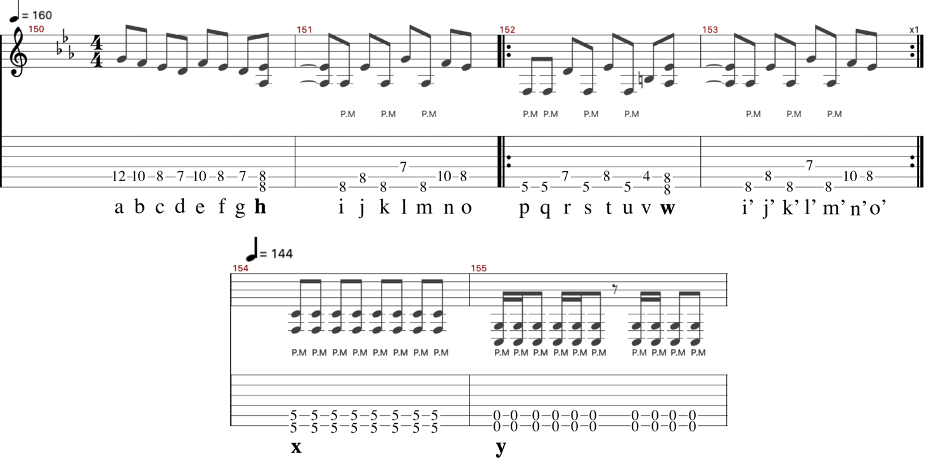
In this section, we focus on the transition from the intricate, fast-paced riff in the verse to the final breakdown, where the tempo slows dramatically (144 BPM) to conclude the song. This shift not only highlights a striking contrast in energy but also presents a compelling example of how different hand positions and transformations facilitate the transition between these two sections. To illustrate this passage in detail, I direct the reader to Example 1, which presents the tablature and score alongside the letter assignments that I have been implementing to the pitches and chords in the previously analyzed sections.
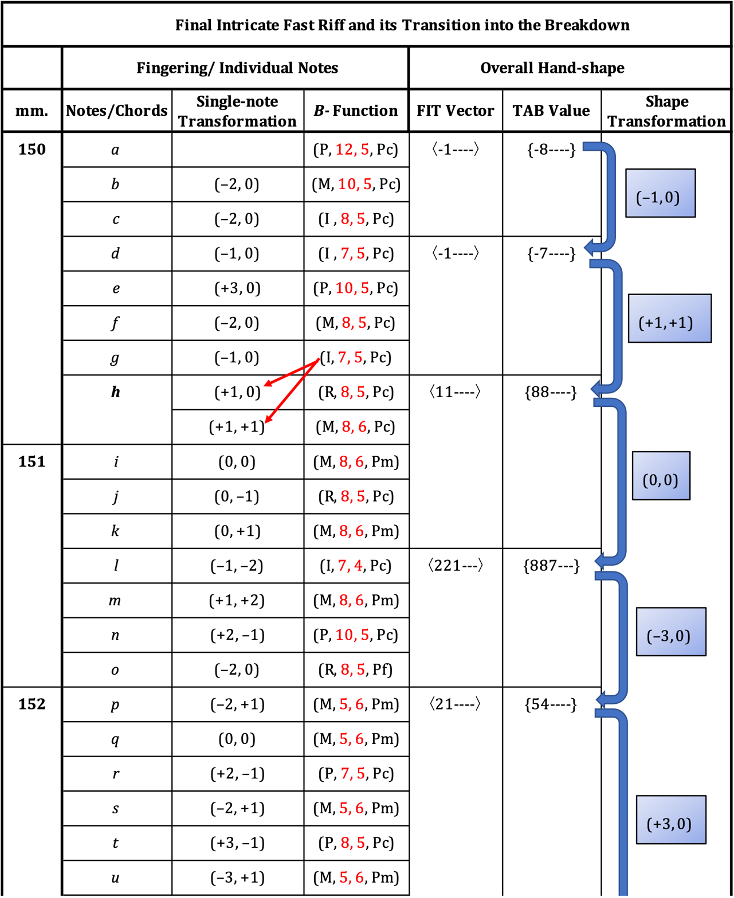
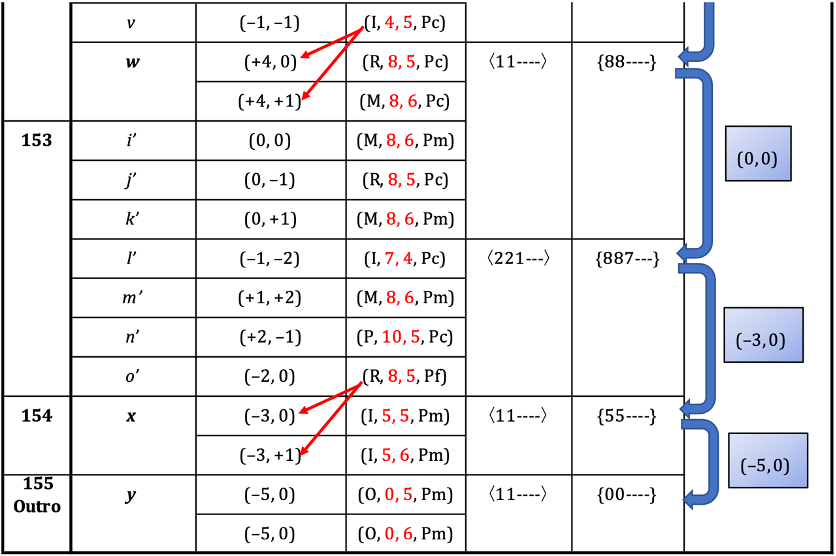
In this section, we remind the reader that power chords are highlighted using bold letters throughout our analysis. Specifically, four power chords appear in this passage: h and w within the intricate verse riff, and x and y in the outro section, marking the transition into the final slow-tempo breakdown. These power chords play a crucial role in shaping the passage’s harmonic and textural contrast, reinforcing the shift from rapid, tightly executed motifs to the heavy, sustained chords of the breakdown. To further explore the transformations and hand positions involved, we invite the reader to examine the table presenting the results of our combined methodology as applied to this section (see Table 1 below).
Additionally, we remind the reader that this table includes red arrows to indicate the transformations from single pitches to power chords, highlighting key shifts in the passage. Specifically, in m. 150, a red arrow marks the transformation from single pitch g to power chord h. Similarly, in m. 152, single pitch v transitions into power chord w, and finally, in m. 153, single pitch o’ moves to power chord x in m. 154. These transformations illustrate how the passage builds harmonic intensity, reinforcing the transition from the fast-paced riff to the heavy breakdown.
The corresponding table results are the core material produced by the combined methodology. They list the transformation attached to each event, the adapted B-function, the TAB representation, and the FIT vector for the relevant hand shape. Including the table is important because it shows the analytical bridge between notation and interpretation: the musical example identifies the passage, while the table records how the passage is physically executed.
Riff and Formal Process
This final section revisits the passage we initially analyzed in the methodology section (Methodology), where we provided a detailed examination of its formal, technical, and transformational characteristics. The corresponding table results have also been previously addressed, offering valuable insights into the complex fretboard navigation and gestural economy involved in its execution. However, in the context of this final analysis, I aim to complement and deepen that earlier discussion, drawing new connections to the broader structural and expressive functions of this passage within the song. This will allow us to highlight not only the technical demands of the riff, but also how it acts as a culminating gesture before transitioning into the breakdown section.
As previously introduced in the methodology section, this final musical section features one of the most technically intricate passages in the entire song (a passage that has also being revised in the first part of the current chapter), a segment that not only plays a climactic musical role but also demands a high level of fretboard control and expressive precision. In this chapter, we now return to this earlier passage—not to reintroduce the analytical methods used, but rather to expand on the interpretive insights of those methods provided and to connect them with the broader performance, compositional, and structural dimensions of the song.
As indicated in Table 1, the fast intricate riff that precedes the breakdown (mm. 150–153) is marked by a rapid descending motif (see m. 150, also referenced in Example 1), immediately followed by a series of tightly constructed riffs that, while spatially compact on the fretboard (never expanding beyond three frets according to the FIT vector column), require rapid alternation between picking techniques, especially palm mute (Pm) and standard picking (Pc). The “B –function column” in Table 1 captures these rapid technique switches in detail, emphasizing the physical and gestural intricacy required to execute such tight rhythmic articulation across strings 4, 5, and 6.
What amplifies the technical demand of this passage is not only the density of articulations but also the lack of repeated notes—each note tends to have its own distinct fingering, requiring consistent repositioning of all four fingers, which is clearly reflected in the data and fingering variations noted in the table. Moreover, the string-crossing activity, occurring in fast succession, introduces another layer of potential challenge for the guitarist. Synchronizing both hands in this context becomes a delicate balancing act, where timing, economy of motion, and mechanical precision are critical for a clean and articulate performance.
Interestingly, the FIT vector values in this section indicate relatively homogeneous hand-shapes, with minimal expansion across frets. This might seem contradictory to the technical complexity shown in the B–function data, but in fact, this is a clear demonstration of how fretboard efficiency and ergonomic positioning play a vital role in performing high-speed riffs. The FIT data points toward a kind of gestural compression—an efficient use of physical space—that allows for complex execution without demanding excessive stretching or repositioning. In other words, the complexity lies not in spatial expansion, but in motivic density and mechanical articulation.
Following this intricate passage, the transition into the breakdown section (starting around m. 154) introduces a significant contrast. The tempo slows to approximately 144 BPM (see Example 1), and the technical texture shifts dramatically. As seen in Table 1, the guitar gestures become more direct and percussive—mostly power chords and palm-muted pedal point riffs, as reflected in the B-function column where Pm becomes the dominant technique. The breakdown section (chords x and y) presents simplified left-hand shapes, designed to prioritize precision and synchronization with the rhythm section, rather than technical flourish.
This shift reflects a common dynamic strategy in metalcore composition: building momentum through virtuosic passages and then dropping into a slower, heavier section designed for maximum impact. In performance contexts, this serves as a peak emotional and physical release, with all instruments—guitars, bass, drums—tightly locked in to produce a dense, mechanical groove. As seen in the full-band score discussed in the longer study, the double bass drumming, power chord reinforcement, and rhythmic unison turn the breakdown into a visceral, body-driven moment, closely tied to the genre’s physical culture (e.g., moshing, headbanging).
It is also worth noting that while the breakdown’s technical surface appears simpler, the shift in character is significant in expressive terms. The reduced fretboard complexity serves to highlight the rhythmic intensity, placing the emphasis squarely on timing, feel, and ensemble cohesion rather than individual virtuosity. The FIT vector and transformation values, despite being minimal in this section, are crucial in conveying this contrast: they visually and numerically articulate how the formal function and expressive purpose of the section are achieved through structural simplicity. This passage thus illustrates the strategic use of technical contrast across the song’s architecture—alternating between dense, intricate sections and stripped-down, rhythm-driven parts.
In summary, this final section reinforces many of the analytical observations made earlier in this chapter. While we had already introduced this passage in the methodology section, its reinterpretation here within the broader structural context of the song allows us to appreciate how fretboard technique, physical economy, and expressive form all converge in the construction of a climactic moment. This prepares the ground for a final reflection on how formal design and technical execution interact in genre-specific ways, which we will continue to explore in the following chapter on broader stylistic implications and genre conventions.
I now turn to the final part of this chapter, which aims to broaden the analytical scope. In the following section, I will examine the overall motion of the song’s formal structure, applying the transformation models not only to individual riffs or segments, but to the interactions between entire sections of the piece. This will allow us to uncover broader patterns of musical movement, structural contrast, and technical progression, offering a comprehensive view of how the song is constructed as an interconnected formal process rather than a collection of isolated parts.
The expressive effect of the passage depends on this reversal of analytical expectations. The fast riff sounds complex because every attack demands precision, yet the left hand often operates within compact positional boundaries. The breakdown sounds simpler because the pitch material is reduced, yet its formal function is decisive: it marks the end of the song’s accumulation of tension and transfers attention from melodic/riff detail to collective rhythmic impact.
Formal Process of “Through Struggle”
On this section I expand the scope of our analysis by shifting from localized riff-based transformations to a broader formal overview of the song. By examining the overall structural motion and the interaction between sections, I aim to contextualize the earlier micro-level data within a macro-level understanding of the song’s construction. This allows us to observe how fretboard transformations, harmonic shifts, and technical contrasts contribute to the cohesive formal logic that defines “Through Struggle”.
Genres such as metalcore frequently rely on the use of open strings to craft rapid, driving riffs that move fluidly across strings and incorporate varied picking techniques—palm muting being one of the most prominent. Within this idiom, the sixth string often holds a central role, functioning not only as the lowest pitch available on the instrument but also as a structural anchor that defines the key and tonal center of many compositions. This is particularly evident in “Through Struggle”, where the song is composed in drop C tuning, making C the lowest and most resonant pitch, and thus establishing C minor as the song’s tonal foundation.
This tuning and tonal framework shape the formal logic of the song, where most sections begin with the root chord (C) or prominently feature it early on, reinforcing the sense of “groundedness” and cohesion across the track. Our first case study serves as an excellent example of this structural convention. In nearly every major section—from the intro and verse riffs to the breakdowns—the material either opens on or gravitates toward C, asserting the key center and aligning with typical genre practices.
However, the chorus presents a noteworthy departure from this pattern, introducing a harmonic contrast that aligns with its melodic and expressive function. Instead of beginning on the tonic (C minor), the chorus unexpectedly opens on A♭ major (the VI chord), shifting the tonal color and creating a moment of surprise and lift. The progression that follows—A♭ major (VI) – F minor (iv) – C minor (i)—provides a modal flavor and a distinct contrast to the surrounding sections, which often emphasize rhythmic aggression and low-register power chord riffs. This harmonic deviation enhances the expressive character of the chorus, where clean vocals and longer sustained chords provide a melodic and textural contrast to the surrounding heavier sections.
In this sense, the formal process of the song is not only driven by the succession of riffs and sectional boundaries, but also by the strategic use of tonality and register, which help articulate moments of contrast, climax, and return. As we apply our transformation models across entire sections rather than individual riffs, we begin to see how the global architecture of the song is constructed through a delicate balance between repetition and contrast, technical complexity and harmonic simplicity, and rhythmic intensity and melodic release.
Before presenting graphic guidance on the application of transformational models to the broader formal structure of the song, it is important to outline the distinct sections that compose “Through Struggle”. Metalcore as a genre often features a rich variety of riff-based sections and breakdowns, frequently incorporating variations and contrasts as a central stylistic trait. In this case study, the song is divided into the following structural components:
Introduction, which features a set of initial long power chords (not included in the present analysis) and is followed by the introductory riff, which we analyzed in the previous analytical sections. This section is followed by a transition fragment where the tempo accelerates, shifting from 160 to 194 BPM (this transition is also part of the current analysis in section 2.2.1).
Verse 1, beginning with the rapid and intricate riff previously analyzed in the previous analytical sections. This is followed by two subsections not covered in the current analysis: a “galloping” section, marked by a rhythmically repetitive and catchy riff with a driving pulse, and an interlude, composed of a heavier, aggressive riff that anticipates into the first chorus.
Chorus, which appears twice in the song. Both iterations are technically identical, though the first is preceded by a “half-time” section (also not included in our analysis), where the tempo drops back to around 164 BPM, creating contrast before the melodic chorus emerges.
Bridge, acting as a separator between the two choruses. This section was discussed in the previous analytical sections featuring a repetitive open-string riff with alternating motifs.
Final Verse, which reprises the intricate riff and connects directly to the final breakdown, the last formal unit of the song. Both of these components were analyzed in detail in Section 2.1.3 and 2.2.3 of the current chapter.
Final Breakdown, serving as the climactic conclusion of “Through Struggle”, delivering a heavy, rhythmically grounded passage that is emblematic of metalcore’s most defining stylistic features. Marked by a significant drop in tempo—returning to approximately 144 BPM—this section contrasts sharply with the preceding intricate riffs. The guitar work becomes more percussive and spacious, relying heavily on palm-muted pedal tones and power chords that emphasize rhythmic precision over melodic complexity (analyzed in Sections 2.1.3 and 2.2.3).
These divisions highlight the genre’s emphasis on dynamic sectional contrast and riff variation. For a clearer overview of these subdivisions, refer to the formal table in the longer study. Notice how in this table I have labeled the section sub-divisions that compound the current analysis of case study 1. You can also find in the last two columns (respectively) the corresponding section in this chapter where the numeric results were generated and their corresponding analytical section.
Now, I would like to use the previously outlined the formal table in the longer study to generate a graphic that visualizes how transformational analysis can be applied to the overall structure of “Through Struggle”. This approach allows us to trace how harmonic and sectional relationships evolve throughout the song. However, it is important to remind the reader that, since most sections begin on the key center of the song (C minor), the transformation values between sections
might not fully capture the internal harmonic variety that occurs within each section—especially when we base our analysis on the first chord of a given section to assign its tonality. Despite this limitation, the transformational model still offers valuable insights into the compositional strategies of the genre. It highlights how harmonic and sectional movements are structured across the piece, reflecting broader patterns of formal tension, contrast, and recurrence. This visualization can help us understand how metalcore songs like “Through Struggle” balance tonal cohesion with localized variation. See Figure 2 for a graphic representation of these inter-sectional transformations.
Figure 2 summarizes the formal process of the case study. It places the passage analyzed above within the larger sectional design of “Through Struggle,” showing how most sections remain attached to C minor while the chorus introduces the strongest harmonic departure through A-flat major. This large-scale view is useful because it shows that the final breakdown is not an isolated event; it is the endpoint of a form that repeatedly balances tonal stability with changes in tempo, density, texture, and performance energy.
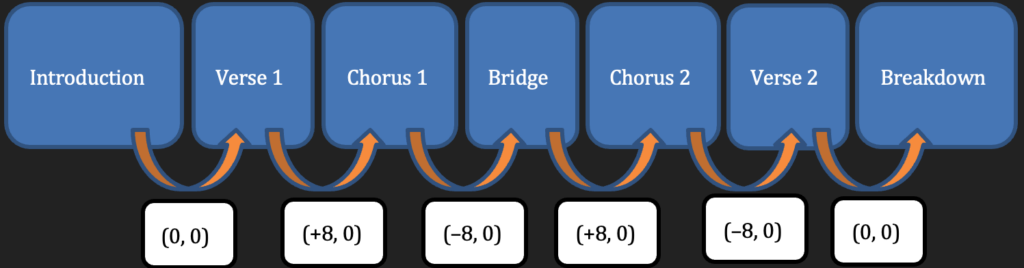
As shown in Figure 2, the only significant harmonic departure from the song’s established key center (C minor) occurs during the transition into the chorus, where the progression shifts to A♭ major to generate a marked contrast. This harmonic leap corresponds to a transformation value of (8, 0)—a distance of eight frets on the guitar—highlighting the intervallic gap between the dominant tonal center of the piece and its most prominent moment of harmonic variation. Aside from these shifts into and out of the chorus, the rest of the song maintains (0, 0) transformation values between sections, reinforcing the tonal stability rooted in C minor. This visual representation demonstrates how metalcore compositions like “Through Struggle” often rely on tonal consistency across sections, while introducing targeted harmonic deviations—such as the chorus—to enhance formal contrast and emphasize expressive climactic points.
The formal process analysis of “Through Struggle” by As I Lay Dying has demonstrated how structural and harmonic features in metalcore compositions can be mapped through transformational values and fretboard-based techniques. As explored in the final section of this chapter, the song’s formal architecture largely revolves around the key center of C minor, with minimal harmonic deviations—most notably during the chorus, where a shift to A♭ major (a transformation of [8, 0]) creates a moment of deliberate contrast. This structural clarity, underscored by the predominance of (0, 0) transformations in the transitions between sections, reflects a common compositional strategy in metalcore: a reliance on tonal consistency interspersed with sharp harmonic contrasts to delineate expressive peaks.
These insights become more vivid when interpreted through the lens of our combined analytical methodology. By applying De Souza’s fretboard transformation theory, the modified Rockwell B-function, and Koozin’s FIT vector analysis, we have gained a multidimensional understanding of how formal design, technical articulation, and physical motion intersect within the song. Each riff examined throughout the chapter revealed distinctive patterns of fretboard movement, efficiency in hand positioning, and picking technique complexity—all of which contribute to the sonic intensity and technical character of the genre.
The verse riff exemplified the intertwining of harmonic stability and physical complexity, requiring high levels of coordination across fingerings, palm muting, and rapid positional shifts. The bridge section reinforced this finding, combining expressive rhythmic density with fretboard economy—a balance between technical demand and ergonomic feasibility that the FIT vectors captured effectively. Similarly, the lead guitar in the chorus demonstrated how melody and harmonic anchoring can coexist through a hybrid riff structure that blends short motifs with power chord injections, again optimized through minimal fretboard displacement.
Finally, the application of transformations to the song’s broader formal layout allowed us to view these micro-level movements within a macro-structural context. Despite the presence of intricate riff variations and transitions, the song remains grounded in a consistent tonal framework, with brief but purposeful departures functioning as structural markers rather than harmonic modulations. This reaffirms how metalcore compositions often privilege rhythmic and technical variation over harmonic complexity, a trait captured effectively by our analytical tools.
This chapter has illustrated how fretboard transformations and motion-based methodologies can yield meaningful insights into the structural, technical, and expressive layers of metal-oriented guitar music. The analytical model applied here serves not only as a descriptive tool, but also as a bridge between performance practice, compositional analysis, and theoretical interpretation—paving the way for broader applications in the study of contemporary metal and beyond.
Conclusion and Discussion
This study set out to investigate the intersection between guitar performance practice, musical form, and transformational theory by developing and applying a combined analytical methodology to selected metalcore compositions of the early 21st century. Drawing from Jonathan De Souza’s fretboard transformation theory, a modified version of Rockwell’s B-function, and a FIT vector analysis inspired by Koozin, this project has aimed to produce a multidimensional analytical toolset that centers the physical and gestural dimensions of guitar playing as integral components of musical structure and expression.
One of the key contributions of this research is the demonstration of how fretboard transformations—viewed through the lens of spatial and gestural logic—can offer a more performance-informed understanding of musical form. Traditional score-based or harmonic analyses tend to overlook the physical movements required to execute riffs, chords, and transitions. In contrast, the combined method allows us to track the strategic use of positional efficiency, hand-shape consistency, and physical gestures such as slides, palm muting, and harmonic articulation. These features, while often absent from conventional notation, are crucial to the embodied experience of metalcore guitar performance and directly shape the expressive and technical character of the music.
The case study of “Through Struggle” exemplifies this well. The song’s structural design remains grounded in the key of C minor throughout, with the sole harmonic shift occurring in the chorus, which moves to A-flat major—a transformation of (8, 0). This moment of contrast is mirrored by a shift in vocal style and instrumental texture, highlighting the chorus as a point of expressive release. Similarly, in “HTML Rulez D00d”, harmonic variation is largely constrained to the introductory and opening verse sections, which deviate briefly from the D minor center. Once the tonal center is established, it remains a consistent anchor throughout the piece, and transformations between sections rarely depart from (0, 0), emphasizing formal clarity and cohesion.
At the micro-level, the analysis of individual riffs using FIT vectors and transformation labels revealed how economy of motion and fretboard logic influence compositional design. For example, the breakdowns and verse riffs in both pieces illustrate how minimal fretboard displacement can coexist with high technical intensity, producing an aesthetic of physical endurance and rhythmic precision that is characteristic of the genre. In particular, instances such as the pinch harmonic in m. 138 of case study 2 showcased how single-note gestures can interrupt otherwise consistent hand shapes, creating expressive peaks that require both technical precision and performative intentionality.
A particularly valuable finding was the divergence between transformation values measured from single pitches versus full hand-shape transitions. This revealed that transformations on the fretboard are not always linear or symmetrical; they can reflect ergonomic compromises or strategic decisions made by performers to optimize fluency, speed, or tonal quality. The combined methodology thus proves itself effective not merely as a theoretical abstraction, but as a means of capturing the lived reality of guitar performance.
While the analytical model has shown significant promise, it is important to acknowledge its limitations. Because the method prioritizes spatial and physical relationships on the fretboard, it may underrepresent certain harmonic subtleties or voice-leading details that would be more apparent in a purely harmonic or Schenkerian approach. Furthermore, the requirement of performance-based transcription and detailed tabular data collection makes the method labor-intensive and less suited for rapid large-scale corpus studies. Nevertheless, the depth and nuance of the insights it offers into performative and structural aspects of guitar music more than justify its methodological demands.
Ultimately, this research has demonstrated that fretboard transformations are not only a useful analytical tool, but also a conceptual bridge between theory, performance, and composition. By centering the embodied experience of the guitarist and considering how physical motion informs musical decisions, we move closer to an integrated understanding of how heavy rock and metalcore function both as musical systems and as performative practices. The findings presented here lay the groundwork for further exploration into how these methods might be applied across other genres, instruments, and compositional styles—offering new ways to connect the analytical with the experiential in music studies.
Because this article includes only the first case study, its conclusions are intentionally more focused than those of the longer thesis. “Through Struggle” demonstrates that fretboard transformations can illuminate the relationship between riff technique and sectional design in a way that traditional score-centered analysis may miss. The method is especially valuable when a passage is physically demanding without being harmonically expansive, or when a formal boundary is marked by a shift in performance behavior rather than a conventional modulation.
While this study has demonstrated the analytical depth and interdisciplinary potential of the combined methodology—integrating fretboard transformation theory, FIT vector analysis, and pitch-class transformational tools—several areas remain open for future exploration. These potential directions not only expand the applicability of the framework developed here but also highlight its flexibility in adapting to diverse musical and instrumental contexts.
Extension 2— Interpreting and Expanding Open-String Hand-Shape Representations
Another key area for further refinement lies in the treatment of open strings. While the current method records open strings as (000—) or similar simplified positional data, this abstraction does not capture the nuanced left-hand strategies performers often use. Even in open-string passages, players frequently engage in tacit hand positioning, preparing subsequent fretted notes, muting inactive strings, or optimizing physical readiness for rapid technical transitions. This is especially relevant in styles such as metalcore, where precise palm muting, rapid alternate picking, or hybrid picking are crucial to stylistic authenticity.
While this study has demonstrated the effectiveness of transformations at both the riff and large-scale sectional levels, further analytical granularity could be achieved by systematically applying transformations to chord progressions within sections and to smaller formal subdivisions. For example, a verse composed of multiple sub-riffs or phrase pairs may reveal internal harmonic or spatial contrasts that are obscured when sections are analyzed as unified blocks. Similarly, transitions between chords within a single progression could be represented as chained transformations, enhancing our ability to map intra-sectional harmonic logic. This approach could lead to a more multi-scalar analysis that moves fluidly between micro- and macro-level interpretations of tonal and gestural structure. Moreover, such work would contribute to broader discussions about how localized transformations serve expressive, structural, or technical purposes, especially in complex compositional idioms like progressive metal or post-hardcore.
Extension 4— Software Development and Algorithmic Applications
Given the systematic and numeric nature of the combined methodology, there is strong potential for its incorporation into software tools. Programs like Guitar Pro, TuxGuitar, or newer platforms based on MIDI sequencing and tablature interfaces could be adapted to include analytical layers derived from fretboard transformations and FIT vectors. Conversely, one could imagine tools that ingest existing MIDI data or audio-derived tablature and output analytical descriptions consistent with the combined methodology, providing immediate insight into technical, harmonic, and structural patterns. Such tools could benefit composers, educators, and music theorists, allowing for automated generation of detailed analytical graphics, position charts, or even gesture-based feedback systems for performance training. In pedagogy, this could foster new ways of teaching fretboard navigation and riff construction, especially for advanced learners seeking to deepen their understanding of how physical motion and harmonic content interact.
Extension 5— Broader Theoretical and Cross-Genre Applications
Finally, the analytical system developed here invites expansion beyond metalcore and heavy rock. Genres such as jazz fusion, math rock, flamenco, and experimental improvisation often prioritize extended technique, alternate tunings, or complex formal structures. The combined methodology—especially with its emphasis on positional transformation and movement economy—could serve as a comparative framework for identifying technical idioms across genres and traditions. Moreover, this approach could contribute to ethnomusicological analysis, especially where oral traditions rely on performance practice rather than notation, as is common in Indian classical music or traditional East Asian repertoires.
In sum, the avenues outlined here suggest that the combined methodology introduced in this article holds promise not only for continued academic inquiry but also for practical application in performance analysis, pedagogy, and digital tool development. Its core strength lies in its capacity to bridge theoretical abstraction and embodied practice—making it a valuable resource for understanding contemporary guitar-based music and potentially transforming the way string instrument technique is analyzed and taught.
Bibliography
Capuzzo, Guy. “Neo-Riemannian Theory and the Analysis of Pop-Rock Music.” Music Theory Spectrum 26, no. 2 (2004): 177-199.
Capuzzo, Guy. “Simultaneous Distinct Headbanging Patterns in Heavy Metal.” Society for Music Theory: Videocast Journal, SMT-V 10, no. 4 (2024).
De Souza, Jonathan. “Fretboard Transformations.” Music Theory Online 24, no. 2 (2018).
De Souza, Jonathan. “Music at Hand: Instruments, Bodies, and Cognition.” Music Theory Online 23, no. 3 (2017).
Easley, David B. “Riff Schemes, Form, and the Genre of Early American Hardcore Punk.” Music Theory Spectrum 37, no. 1 (2015): 25-41.
Hudson, Stephen S. “Compound AABA Form and Style Distinction in Heavy Metal.” Journal of Music Theory Pedagogy 34, no. 2 (2020): 123-45.
Koozin, Timothy. “Guitar Voicing in Pop-Rock Music: A Performance-Based Analytical Approach.” Music Theory Online 17, no. 3 (2011).
Momii, Toru. “A Transformational Approach to Gesture in Shō Performance.” Music Theory Online 26, no. 2 (2020).
Momii, Toru. “Performing Te: Gesture and Timbre in Fujikura Dai’s neo for Solo Shamisen.” Music Theory Spectrum 46, no. 2 (2024).
Rockwell, Joti. “Banjo Transformations and Bluegrass Rhythm.” Journal of the American Musicological Society 62, no. 3 (2009): 567-636.
Shea, Nicholas J. “The Feel of the Guitar in Popular Music Performance.” SMT-V: Videocast Journal of the Society for Music Theory 8, no. 3 (May 2022).
Van Valkenburg, Aaron. “Musical Process and the Structuring of Riffs in Metallica.” Master’s thesis, Baylor University, 2017.
MuseScore. “Through Struggle” – As I Lay Dying. Accessed December 29, 2024. https://musescore.com/user/12383771/scores/6534899.
Phil Sgrosso. “As I Lay Dying Guitar Playthroughs.” PhilSgrossoVideo (YouTube channel). Accessed December 29, 2024. https://www.youtube.com/@PhilSgrossoVideo.
Songsterr. “Through Struggle Tab by As I Lay Dying.” Accessed December 29, 2024. https://www.songsterr.com/a/wsa/as-i-lay-dying-through-the-struggle-tab-s29607.
[1] Jonathan De Souza, “Fretboard Transformations,” Music Theory Online 24, no. 2 (2018).
[2] Joti Rockwell, “Banjo Transformations and Bluegrass Rhythm,” Journal of the American Musicological Society 62, no. 3 (2009): 567–636.
[3] Toru Momii, “Performing Te: Gesture and Timbre in Fujikura Dai’s neo for Solo Shamisen,” Music Theory Spectrum 46, no. 2 (2024). Momii also develops gesture-based transformational approaches in “A Transformational Approach to Gesture in Shō Performance,” Music Theory Online 26, no. 2 (2020).
[4] A power chord is a common rock and heavy metal sonority consisting of the root, fifth, and often the octave, typically played with distortion to achieve an aggressive sound.
[5] Nicholas J. Shea, “The Feel of the Guitar in Popular Music Performance,” SMT-V: Videocast Journal of the Society for Music Theory 8, no. 3 (May 2022).
[6] Timothy Koozin’s fret-interval vector represents the overall shape of the hand on the guitar fretboard by focusing on relative distances between fretted positions rather than individual finger assignments.
[7] Timothy Koozin, “Guitar Voicing in Pop-Rock Music: A Performance-Based Analytical Approach,” Music Theory Online 17, no. 3 (2011).
[8] Silent strings are represented here with the sign “–” in order to align with Koozin’s fret-interval nomenclature, although guitar tablature often represents muted or unplayed strings with “x.”
[9] FIT vectors are enclosed in angle brackets, following Koozin’s original notation.
[10] Guy Capuzzo, “Neo-Riemannian Theory and the Analysis of Pop-Rock Music,” Music Theory Spectrum 26, no. 2 (2004): 177–199.
[11] Guy Capuzzo, “Simultaneous Distinct Headbanging Patterns in Heavy Metal,” SMT-V: Videocast Journal of the Society for Music Theory 10, no. 4 (2024).